


How PoE Monitors and PoE Injectors Simplify Conference Room Signage and Status Displays
April 2026
Conference rooms, government facilities, and large commercial buildings require clear, accessible signage: room status, classification levels, wayfinding, and scheduling information. Adding or relocating displays in finished or secure spaces typically means new electrical circuits, permits, and disruption.
Power over Ethernet (PoE) digital signage solves this by combining data and power delivery over a single Ethernet cable. PoE displays require no dedicated electrical circuit, no AC outlet, and no separate PoE splitter at each installation point. Deployments are faster, cleaner, and easier to reconfigure.
Let’s explore how GPO Display's PoE-powered monitors and panoramic LCDs, paired with TRENDnet's PoE++ injectors, address conference room signage, room status displays, and related applications.
About GPO Display
GPO Display is a California-based manufacturer of commercial-grade LCD and OLED display solutions. Their displays are commonly used in corporate, education, and hospitality environments. All of their displays are TAA-compliant, making them popular for U.S. government and federal procurement.
Why PoE Makes Sense for Digital Signage Displays
Traditional digital signage requires two separate runs to every display: a network cable for content and a power cable to an AC outlet. In finished spaces, secure facilities, or above-door installations, adding an AC circuit means electrical work, permits, and disruption.
PoE eliminates the power run entirely. Any space with existing structured cabling can support a PoE display wherever an Ethernet drop exists, with no electrician, no new conduit, and no outlet placement required.
For IT and AV integrators, this reduces installation time and total project cost. For facilities managers in government buildings, it also simplifies physical security planning, since there are fewer exposed AC connections and junction boxes to account for.
Use Cases Where PoE Displays Deliver the Most Value
Room Status & Classification Signage
The most common deployment GPO Display and TRENDnet see for PoE monitors is room status signage, typically mounted above doorways or alongside larger displays in conference rooms. In U.S. military and federal facilities, there is a firm requirement for signage that clearly communicates a room's classification status (classified vs. unclassified). Many civilian agencies handling sensitive information have adopted similar standards.
GPO's wide-format displays, powered and networked by TRENDnet PoE++ injectors, provide ample room for room classification status, multi-time zone clocks, room occupancy, schedule availability, and microphone or camera active indicators, all from a single network-connected display powered by the same cable carrying its data.
Directional & Directory Signage
Large buildings, government campuses, and corporate headquarters present ongoing wayfinding challenges. PoE panoramic LCDs, along with PoE++ injectors, fit naturally above corridors and doorways and in tight wall spaces where a standard 16:9 display would be impractical. Content can be updated centrally and instantly, which is a clear advantage over static printed directories.
Dynamic Room Identification
City council chambers, courtrooms, and legislative facilities often require dynamic nameplate displays that can be updated between sessions. PoE displays can be updated remotely without requiring physical access to each unit.
GPO’s recently launched PoE panoramic display, POE57D, measures 57" diagonal with a resolution of 3840x430. It delivers Ultra-HD content in a panel that is roughly the same width as a standard 65" 4K display, but one-fifth the height. Along with a TRENDnet PoE++ injector, it is well suited for world clocks, headline tickers, and classification status banners where maximum horizontal span and sharp resolution are priorities.
TRENDnet PoE++ Injectors: Matching the Power Demand
GPO's full PoE display lineup, from the 21.5" monitors up to the 57" POE57D, requires 802.3bt Type 4 (PoE++, up to 90-95W) power delivery. TRENDnet offers nine PoE++ injectors suited to these deployments, depending on the environment. Today we’re diving into two of GPO’s favorites to recommend: TPE-119G and TI-IG290.
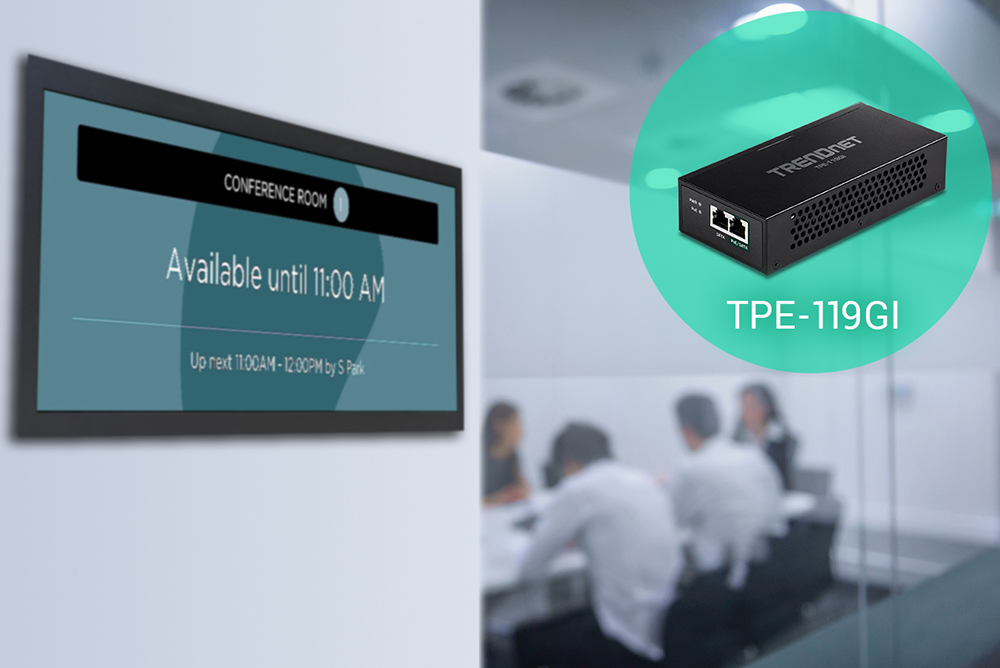
TPE-119GI: Gigabit PoE++ Injector
The TPE-119GI is a single-port 802.3bt injector delivering up to 95W over Gigabit Ethernet. Auto-sensing technology negotiates the correct wattage for connected devices, whether PoE (15.4W), PoE+ (30W), or PoE++ (95W), covering the entire GPO display range without manual configuration. Its wall-mount design and metal enclosure suit finished interior spaces. The TPE-119GI is NDAA/TAA compliant.
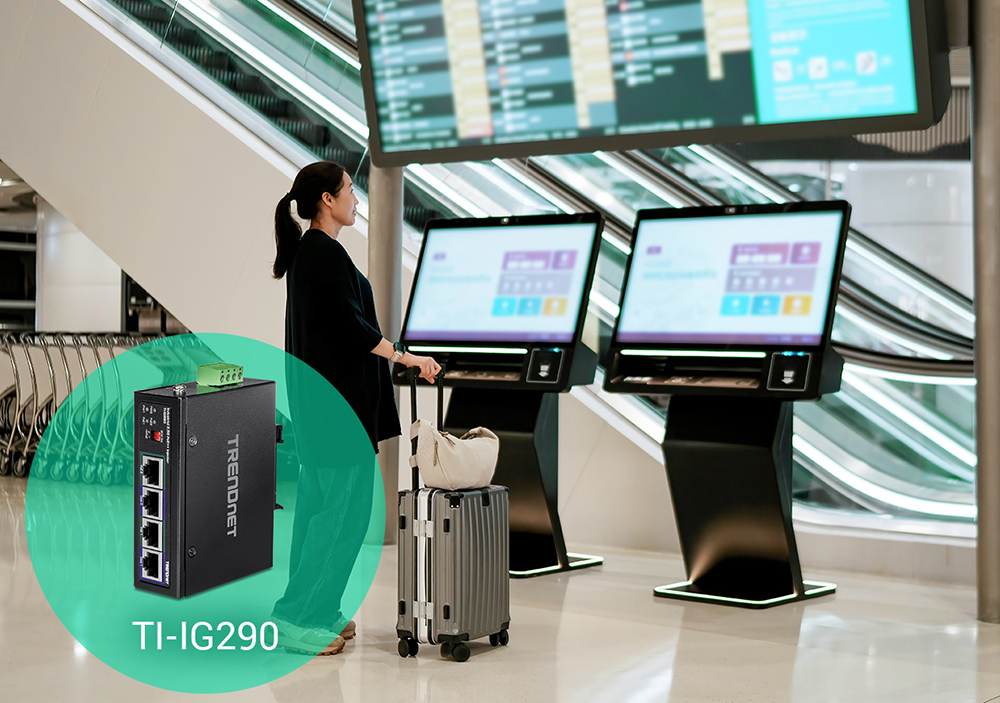
TI-IG290: Industrial 2.5G PoE++ Injector
For deployments in demanding environments, TRENDnet's TI-IG290 is a 2-port industrial injector with specifications designed for harsh conditions:
- Operating temperature range of -40°C to 75°C (-40°F to 167°F)
- IP30-rated metal enclosure with certified shock (IEC 60068-2-27), freefall (IEC 60068-2-6), and vibration resistance
- Redundant power inputs and 2KV surge protection
- 2.5G ports with a 180W total PoE budget across two ports
- Fanless design for silent, maintenance-free operation
- DIN-Rail and wall mount included
The TI-IG290 is also NDAA/TAA compliant, satisfying supply chain provenance requirements for secure government facilities.
Guaranteed Reliability
Together, GPO Display's PoE monitors and panoramic LCDs and TRENDnet's PoE++ injectors reduce a digital signage deployment to its core components: a network drop, a display, and an injector where a PoE switch is not already in place. No separate power circuit, no splitter, no additional hardware between the switch and the screen.
For integrators, that simplicity means faster installs and more predictable projects. For government and federal procurement teams, the combination of TAA compliance, NDAA compliance, and 24/7-rated hardware meets the baseline requirements for most U.S. government deployment scenarios.
Explore GPO Display's full PoE display lineup at gpodisplay.com, and find TRENDnet's PoE++ injectors at trendnet.com.